IBC
Visit
3312 Broadway St NE
Minneapolis, MN 55413
The average IBC tote is engineered to last 5-7 fill cycles, yet most get crushed after one. We're changing that -- one tote at a time, across the entire Twin Cities.
Most people think about plastic bags and water bottles when they hear "plastic waste." But the industrial sector is one of the largest producers of plastic waste in the country, and IBC totes are a major contributor. An intermediate bulk container -- the standard 275-gallon or 330-gallon tote used to store and transport liquids -- contains approximately 33 pounds of high-density polyethylene in its inner bottle alone. Add the steel cage frame (roughly 60 pounds), the wooden or plastic pallet, and the valve assembly, and you're looking at over 130 pounds of material per unit.
In Minnesota alone, an estimated 50,000 IBC totes are discarded every year. Across the Upper Midwest, that number climbs past 200,000. The vast majority end up crushed and landfilled, even though the containers are in perfectly serviceable condition. The economics of the traditional supply chain make it cheaper to buy new than to figure out what to do with the empties. That's the problem we set out to solve.
When you account for the petroleum used to produce the HDPE, the energy consumed in manufacturing, the water used in processing, and the emissions from transportation, a single new IBC tote carries a carbon footprint of roughly 120 pounds of CO2. Multiply that by hundreds of thousands of totes discarded annually, and you begin to understand the scale of the opportunity for reuse.
These are the real, measurable savings from choosing a reused IBC tote over a newly manufactured one.
~33 lbs
Plastic Saved
Each reused IBC tote keeps approximately 33 pounds of high-density polyethylene (HDPE) out of the waste stream. HDPE takes 450+ years to decompose in a landfill.
~120 lbs
CO2 Prevented
Manufacturing a new IBC tote from virgin materials generates roughly 120 lbs of CO2 emissions -- from petroleum extraction to plastic molding to transportation.
~1,100 gal
Water Conserved
Producing a new HDPE bottle for an IBC requires approximately 1,100 gallons of water. Reusing an existing tote bypasses this entirely.
~42 kWh
Energy Saved
The energy required to manufacture one new IBC tote from scratch could power an average Minnesota home for over a day. Reuse skips the most energy-intensive steps.
85%
Water Recycled
Our commercial wash system recycles 85% of the water used in cleaning. The remaining 15% is properly treated before discharge, meeting all MPCA standards.
0 lbs
Landfill Waste
Our facility operates at zero landfill waste. Every component of every tote -- plastic, steel, wood, gaskets -- is either reused or sent to a material-specific recycler.
In 2024 alone, we processed over 8,000 IBC totes
That's roughly 264,000 lbs of plastic diverted from landfill, 960,000 lbs of CO2 emissions prevented, and 8.8 million gallons of water conserved.
Our entire business model is built on keeping materials in use for as long as possible. Here's how an IBC tote moves through our system.
We pick up used IBC totes from manufacturers, distributors, and warehouses across the Twin Cities and beyond. Many of these totes would otherwise be crushed and sent to a landfill after a single use.
Every tote is inspected for structural integrity, UV damage, chemical residue, and overall condition. We grade each one (A through C) so customers know exactly what they're getting. Totes that can't be resold move to reconditioning or recycling.
Reusable totes go through our commercial wash system -- triple-rinsed, pressure-washed, and sanitized. If needed, we replace gaskets, valves, and fittings. Our wash system recycles 85% of its water.
Clean, inspected totes go back into service. A typical IBC tote is engineered for 5 to 7 refill cycles. Most that come through our facility have only been used once. That's years of useful life left.
When a tote truly can't be reused, we disassemble it. The HDPE bottle is shredded and sent to a plastics recycler. The galvanized steel cage goes to a metal recycler. The wood pallet is chipped for biomass. Nothing goes to waste.
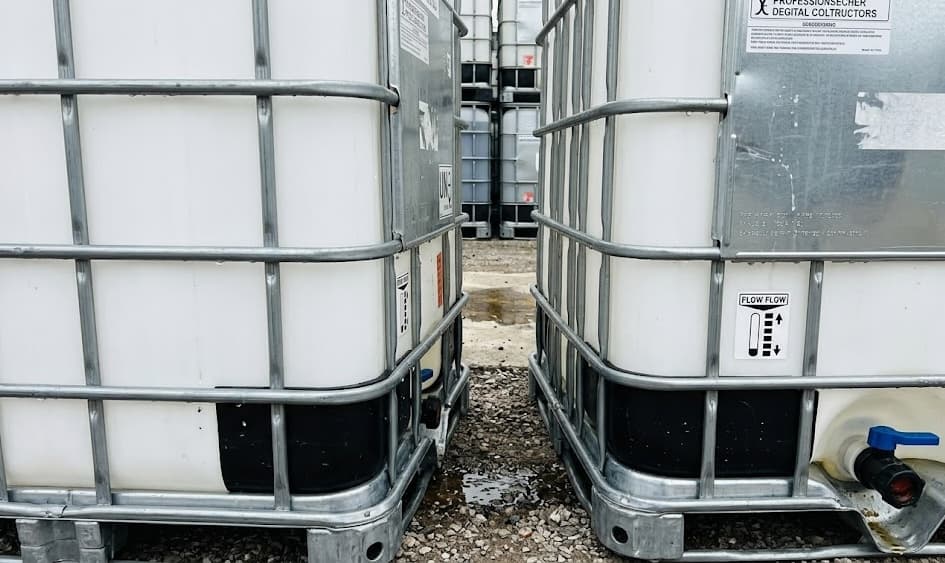
The anatomy of a circular product — galvanized steel cage and HDPE bottle are both 100% recyclable, keeping materials in use across multiple lifecycles.
Sustainability at IBC Minneapolis isn't limited to what we do with totes. It's built into every aspect of our operations at our 12,000-square-foot facility on Broadway Street NE.
Our wash system is a closed-loop design that captures, filters, and recirculates 85% of the water used in cleaning. The remaining wastewater is treated on-site to meet Minnesota Pollution Control Agency standards before discharge. We use biodegradable, phosphate-free cleaning agents that are effective on food-grade residue without adding harmful chemicals to the water supply.
When we disassemble end-of-life totes, every component is separated by material type. HDPE plastic is shredded on-site and shipped to a regional plastics recycler where it becomes drainage pipe, landscape edging, and other durable goods. Steel cages are baled and sent to a scrap metal processor. Wood pallets are either repaired and reused or chipped for biomass fuel. Even valve assemblies and gaskets are sorted for recycling where possible.
Our closed-loop wash system reduces freshwater consumption by 85% compared to a conventional single-pass setup. We track water usage monthly and set annual reduction targets. In 2024, we used an average of just 3.2 gallons of fresh water per tote cleaned.
Our transport fleet runs optimized routes to minimize fuel consumption and emissions. We batch pickups and deliveries by geographic area and prioritize full-truck loads. We're currently evaluating hybrid and electric options for our next fleet expansion.
In 2024, our overall material recovery rate was 99.6%. Of the 8,000+ totes we processed, zero went to landfill in whole form. The 0.4% that wasn't recovered consisted of heavily degraded gasket material and adhesive residue -- and we're working on solutions for even that.
Every customer who buys reconditioned totes from us receives an environmental impact certificate showing the estimated plastic diverted, CO2 prevented, and water saved through their purchase. It's a tangible way to document your company's sustainability efforts.
The plastics crisis isn't just a consumer problem. Industrial plastic waste -- including IBC totes, drums, stretch wrap, and pallet packaging -- accounts for a massive share of total plastic production and disposal. Unlike consumer plastics, industrial containers are often used once and discarded without any attempt at recycling, because the logistics of collecting, cleaning, and redistributing them are complex.
That complexity is exactly what we've built our business to handle. We have the trucks, the facility, the inspection process, and the customer network to make IBC tote reuse practical and profitable -- not just for us, but for every business in our supply chain. The manufacturer who sells us their empties makes money. The customer who buys reconditioned saves money. And the environment benefits from every tote that stays in circulation instead of going to a landfill.
Minnesota has set ambitious waste reduction and recycling targets for the coming decade. We believe businesses like ours -- focused on specific material streams and operating at the local and regional level -- are the key to actually hitting those targets. National policy sets the direction, but local operators do the work.
If your company is looking to reduce its environmental footprint, switching to reconditioned IBC totes is one of the easiest, most cost-effective changes you can make. You save money, you reduce waste, and you get the exact same functional performance as a new container.
The ~120 lbs of CO2 saved per reused tote isn't a single number -- it's the sum of emissions avoided across every stage of the IBC lifecycle. Here's exactly where those savings come from.
| Lifecycle Stage | New Tote (CO2) | Reused Tote (CO2) | CO2 Saved |
|---|---|---|---|
Petroleum Extraction & Refining Virgin HDPE requires crude oil extraction, refining to naphtha, and cracking to ethylene. Reuse eliminates this entirely. | ~28 lbs | 0 lbs | 28 lbs |
HDPE Polymerization & Pelletizing Converting ethylene into HDPE resin pellets is energy-intensive, typically using natural gas-fired reactors. | ~22 lbs | 0 lbs | 22 lbs |
Blow Molding (Bottle Formation) Heating HDPE to 400F+ and pressure-molding it into a tote bottle consumes significant electricity and generates process emissions. | ~18 lbs | 0 lbs | 18 lbs |
Steel Cage Manufacturing Galvanized steel tubing production, cutting, welding, and zinc coating all carry substantial carbon footprints. | ~25 lbs | 0 lbs | 25 lbs |
Pallet & Assembly Wood pallet milling, assembly, and final IBC unit assembly at the manufacturing plant. | ~8 lbs | 0 lbs | 8 lbs |
Transportation to End User New totes ship from factories in Texas, Ohio, or overseas. Our reused totes travel locally -- usually under 50 miles. | ~15 lbs | ~4 lbs | 11 lbs |
Cleaning & Reconditioning Our wash and reconditioning process does use some energy and water, but it's a fraction of new manufacturing. | 0 lbs | ~4 lbs | -4 lbs |
End-of-Life Disposal New totes often go to landfill after one use. Our totes are disassembled and recycled with minimal residual waste. | ~4 lbs | ~0.5 lbs | 3.5 lbs |
| Total | ~120 lbs | ~8.5 lbs | ~111.5 lbs |
Figures are based on lifecycle analysis data from the American Chemistry Council, EPA WARM Model, and our own operational measurements. Actual savings vary based on tote size, previous use, transportation distance, and reconditioning requirements.
Water is one of the most overlooked resources in industrial manufacturing. Here's how IBC tote reuse saves water at every stage -- from raw material to delivery.
~1,100 gal
Producing a single new HDPE bottle requires approximately 1,100 gallons of water. This includes water used in petroleum refining (cooling towers, steam generation, washing), the polymerization process itself (reactor cooling, pellet quenching), and the blow molding stage (mold cooling systems). None of this water is consumed when you reuse an existing tote. For context, 1,100 gallons is roughly equivalent to 22 full bathtubs -- saved with every single tote that gets a second life instead of going to the crusher.
3.2 gal
Our commercial wash system uses an average of just 3.2 gallons of fresh water per tote cleaned -- down from 21 gallons per tote when we used a conventional single-pass system. The closed-loop design captures rinse water, filters it through a multi-stage sediment and carbon filtration system, and recirculates it for the next wash cycle. The system recycles 85% of all water used. The remaining 15% -- water that's too contaminated for reuse -- is treated on-site through our settling tanks and filtration system to meet MPCA discharge standards before entering the municipal system. We test water quality weekly and submit quarterly reports to state regulators.
~85 gal
It's not just direct water use. The diesel fuel burned during long-distance transportation has an embedded water footprint -- water used in crude oil extraction, refining, and fuel production. A new IBC tote shipped from a factory in Houston or Akron travels 1,000+ miles by truck. Our reused totes travel an average of 35 miles within the Twin Cities metro. The reduced fuel consumption translates to approximately 85 gallons of embedded water saved per tote through shortened supply chains. When you multiply this across 8,000 totes annually, that's 680,000 gallons of water embedded in fuel that never needed to be consumed.
Total water savings per reused tote: ~1,182 gallons
In 2024, our operations conserved an estimated 9.4 million gallons of water -- enough to fill 14 Olympic swimming pools.
Sustainability isn't just about what we do with the totes. It's built into every aspect of how our Broadway Street facility operates. Here are eight specific practices that make our operation one of the greenest in the region.
Our rooftop solar installation generates approximately 38,000 kWh annually -- enough to offset roughly 60% of our facility's electricity consumption. The 96-panel array was installed in 2023 and pays for itself through reduced utility costs while cutting our grid-sourced energy demands. During peak summer months, we actually feed excess power back to the grid through Xcel Energy's solar rewards program.
We collect rainwater from our 12,000 sq ft roof through a gutter and filtration system that feeds two 2,500-gallon storage tanks (repurposed IBC tote assemblies, naturally). This captured rainwater is used for initial pre-rinse washing of totes -- the dirtiest phase that doesn't require potable water quality. In an average Minnesota rain year, we capture approximately 45,000 gallons, further reducing our municipal water consumption.
All three of our forklifts are battery-electric, producing zero direct emissions inside the facility. This eliminates the carbon monoxide, nitrogen oxides, and particulate matter that propane or diesel forklifts would generate inside an enclosed warehouse space. The forklifts are charged overnight using a combination of stored solar energy and off-peak grid power. Annual fuel cost savings versus propane forklifts: approximately $4,200.
Every light fixture in the facility has been upgraded to LED, including the high-bay warehouse lights, inspection bay task lighting, office fixtures, and exterior security lights. LEDs use 75% less energy than the fluorescent and HID fixtures they replaced. We also installed skylights in the inspection and wash bay areas, allowing us to operate without artificial lighting during daylight hours on clear days. Motion sensors in low-traffic areas automatically shut off lights when spaces are unoccupied.
All inventory tracking, inspection records, customer invoicing, delivery scheduling, and environmental impact certificates are managed digitally. We transitioned to a fully paperless system in 2022, eliminating an estimated 18,000 pages of annual paper consumption. Drivers use tablets for delivery confirmations and route management. Customers receive digital inspection reports and invoices via email. The only paper in our facility is the occasional label on an incoming tote.
All organic waste generated at the facility -- break room food scraps, coffee grounds, wood chips from damaged pallets, and biodegradable cleaning agent residue -- goes into our on-site composting system. The resulting compost is donated to community gardens in Northeast Minneapolis. It's a small stream (approximately 800 lbs per year), but it means even our food waste stays out of the landfill and contributes to soil health in the local community.
When a tote reaches end of life, it doesn't get thrown away -- it gets disassembled into five material streams, each with a dedicated recycling partner. HDPE bottles are shredded on-site and sent to a regional plastics recycler. Steel cages are baled and shipped to a scrap metal processor. Wood pallets are repaired or chipped for biomass fuel. Valve assemblies are sorted by metal type. Rubber gaskets go to a specialty crumb rubber processor. This multi-stream approach achieves a 99.6% material recovery rate.
Our logistics coordinator uses route optimization software that batches pickups and deliveries by geography, minimizes deadhead (empty) miles, and prioritizes full-truck loads. In 2024, route optimization reduced our total fleet miles driven by an estimated 18% compared to a naive scheduling approach. That translates to approximately 4,200 fewer gallons of diesel consumed and 96,000 fewer pounds of CO2 emitted annually. We also combine pickup and delivery runs whenever possible, so a truck delivering totes in Eagan picks up empties from another customer on the same trip.
Our environmental commitments are verified by third-party certifications and regulatory compliance. Here are the standards we meet or exceed.
Awarded by the Minnesota Pollution Control Agency in 2023. This certification verifies that our facility meets or exceeds state standards for wastewater treatment, air quality, hazardous material handling, and material recovery. The certification requires an annual facility audit, quarterly water quality reports, and documentation of all waste streams. We were the first IBC reconditioning facility in Minnesota to achieve this designation.
Our transport fleet is registered under the EPA's SmartWay program, which benchmarks freight-related emissions and fuel efficiency. As a SmartWay partner, we track and report fuel consumption, CO2 emissions per ton-mile, and idle time across our fleet. The program provides third-party verification that our logistics operations meet federal efficiency standards, and it gives customers with sustainability reporting requirements documented proof that their transportation vendor is committed to emissions reduction.
Certified by the Institute of Scrap Recycling Industries as a compliant recycling facility for both plastics and metals. This certification confirms that our material separation and recycling processes meet industry standards for contamination control, material traceability, and responsible downstream processing. It ensures that when we say a tote component was "recycled," it actually entered a verified recycling stream and was processed into new materials.
Our Grade A reconditioned totes that are designated for food-contact use meet the requirements of FDA 21 CFR 177.1520, which governs olefin polymers (including HDPE) intended for food-contact applications. This means the HDPE material, our cleaning agents, and our reconditioning process are all compliant with federal food safety regulations. Customers in food and beverage manufacturing can confidently use our Grade A totes for storing and transporting food-grade liquids.
Issued by the Minnesota Chamber of Commerce in partnership with the MPCA, this certification recognizes businesses that demonstrate measurable environmental performance across energy use, water conservation, waste reduction, and community impact. Our application documented our solar installation, closed-loop wash system, 99.6% material recovery rate, and community programs. The certification is reviewed and renewed every two years.
Our reconditioned IBC totes comply with UN 31HA1 specifications and Department of Transportation (DOT) requirements for the storage and transport of non-hazardous liquids. This includes proper marking and labeling, structural integrity testing, leak-proof certification, and documentation of reconditioning activities. For customers who need to transport materials by road, rail, or intermodal, our compliant totes meet all applicable federal shipping regulations.
The scale of the global plastic waste problem is staggering -- and industrial containers like IBC totes are a significant but often overlooked contributor. Here are ten facts that put the crisis in perspective.
380 Million Tons of Plastic Produced Annually
Global plastic production has surpassed 380 million metric tons per year and is projected to double by 2040. Industrial plastics -- including IBC totes, drums, and bulk packaging -- account for approximately 36% of total production.
Source: OECD Global Plastics Outlook, 2022
Only 9% of All Plastic Ever Made Has Been Recycled
Despite decades of recycling programs, only 9% of the 8.3 billion metric tons of plastic produced since the 1950s has been recycled. 12% has been incinerated. The remaining 79% sits in landfills or the natural environment. IBC tote reuse directly combats this by keeping containers in active service for years.
Source: Science Advances, "Production, use, and fate of all plastics ever made," 2017
HDPE Takes 450+ Years to Decompose
The high-density polyethylene used in IBC tote bottles is extremely durable -- which is exactly what makes it great for industrial use and terrible for landfills. A single HDPE bottle discarded today will still be sitting in a landfill in the year 2475. Every tote we keep in circulation delays or prevents that outcome entirely.
Source: U.S. National Park Service / NOAA Marine Debris Program
1.8 Billion Barrels of Oil Used for Plastics Annually
The plastics industry consumes roughly 4-8% of global oil production as feedstock. Each 33-lb HDPE IBC bottle requires approximately 2.5 gallons of petroleum equivalent to produce. Reusing that bottle eliminates the petroleum demand entirely and reduces dependence on fossil fuels in the industrial supply chain.
Source: World Economic Forum, "The New Plastics Economy," 2016
200,000+ IBC Totes Landfilled Annually in the Upper Midwest
Across Minnesota, Wisconsin, Iowa, and the Dakotas, an estimated 200,000+ IBC totes are discarded every year after a single use. At 33 lbs of HDPE each, that's 6.6 million pounds of industrial-grade plastic going to landfill annually in our region alone. Our operation diverted 8,000 of those totes in 2024, but the opportunity to scale is enormous.
Source: IBC Minneapolis internal estimates based on MPCA waste data
IBC Totes Are Designed for 5-7 Uses -- Most Get Just 1
An IBC tote is engineered and pressure-tested for 5 to 7 fill cycles. The HDPE bottle maintains structural integrity through multiple cleaning and refill operations. Yet the vast majority of IBC totes in commercial use are discarded after a single fill because there's no infrastructure to collect, clean, and redistribute them. That infrastructure is exactly what we built.
Source: HDPE manufacturer specifications; Schutz Container Systems
Plastics Account for 3.4% of Global Greenhouse Emissions
The lifecycle of plastics -- from production to incineration -- generated an estimated 1.8 billion metric tons of greenhouse gas emissions in 2019, roughly 3.4% of global totals. Industrial plastics contribute disproportionately because of their higher weight and the energy-intensive manufacturing processes involved. Every tote reused avoids ~120 lbs of CO2 that would have been generated in new manufacturing.
Source: Nature Reviews Earth & Environment, 2022
Landfill Space in Minnesota Is Running Out
Minnesota's landfills have approximately 25-30 years of remaining capacity at current disposal rates. Industrial waste -- including bulky items like IBC totes -- takes up disproportionate space. A single IBC tote occupies roughly 48 cubic feet of landfill volume. Keeping 8,000 totes out of landfills each year saves approximately 384,000 cubic feet of disposal capacity -- the equivalent of 14,200 cubic yards.
Source: MPCA "Report on the State of Minnesota's Landfills," 2023
Industrial Plastic Recycling Rates Are Below 15%
While consumer plastic recycling gets most of the public attention, industrial plastic recycling rates are actually lower -- estimated at just 10-15% nationally. The main barriers are contamination (chemicals, food residue), logistics (collection from dispersed industrial sites), and economics (new plastic is often cheaper than recycled). IBC tote reuse bypasses recycling entirely by extending the product's original useful life.
Source: EPA "Advancing Sustainable Materials Management" report
Reuse Is 8x More Effective Than Recycling
According to lifecycle analysis studies, reusing a container prevents 8 times more CO2 emissions than recycling and remanufacturing it. That's because reuse avoids the energy-intensive steps of shredding, melting, re-pelletizing, and re-molding. Our business model prioritizes reuse first and recycling second -- recycling is the last resort for totes that truly can't be reused, not the default.
Source: Ellen MacArthur Foundation, "Reuse: Rethinking Packaging," 2019
Where we've been is just the beginning. Here's our concrete plan for the next six years -- with measurable targets and specific timelines.
Close the final 0.4% gap in our material recovery rate by establishing recycling partnerships for the remaining hard-to-recycle materials: adhesive residues, heavily degraded gasket rubber, and contaminated label stock. Target: 100% diversion from landfill for every gram of material that enters our facility.
Status: In Progress -- currently at 99.6%
Scale our operations to process 12,000 IBC totes per year -- a 50% increase over our 2024 volume. This will require expanding our wash bay capacity, adding a second inspection station, and hiring three additional warehouse team members. At 12,000 totes, we'll prevent an estimated 1.44 million lbs of CO2 and divert 396,000 lbs of plastic annually.
Status: Planning -- facility expansion quotes received
Begin transitioning our delivery fleet from diesel trucks to electric or hybrid vehicles. Phase 1 targets replacing two of our five trucks with electric medium-duty flatbeds by end of 2025. We're evaluating models from Freightliner (eCascadia), BYD, and Rivian commercial. On-site Level 2 charging stations will be powered primarily by our solar installation.
Status: Research phase -- test drives scheduled Q2 2025
Upgrade our closed-loop wash system to achieve 92% water recycling (up from 85%), reducing fresh water consumption from 3.2 gallons per tote to 2.0 gallons. This will involve adding an advanced filtration stage (UV sterilization + reverse osmosis) that allows more wash water to be safely recirculated. Combined with expanded rainwater capture, we aim to reduce municipal water usage at the facility by 50%.
Status: Scoped -- filtration system vendor selected
Reach net-zero carbon emissions for all facility operations (excluding fleet) through a combination of expanded solar capacity, energy efficiency upgrades, and verified carbon offsets for any remaining emissions. This means our warehouse, wash bay, offices, and equipment will operate without net greenhouse gas output. Third-party verification will be conducted annually.
Status: Long-range planning
More than triple our 2024 volume by expanding to a larger facility or opening a second location in the Twin Cities metro. At 25,000 totes per year, we would divert 825,000 lbs of HDPE plastic and prevent 3 million lbs of CO2 emissions annually. This scale would make a meaningful dent in the estimated 200,000 IBC totes landfilled in the Upper Midwest each year.
Status: Long-range planning
Complete the transition to an all-electric delivery fleet, eliminating diesel consumption entirely from our operations. By 2029, we expect electric medium-duty truck range and charging infrastructure in Minnesota to support full-day route coverage without range constraints. Combined with our solar-powered facility, this will make IBC Minneapolis a near-zero-emission operation from end to end.
Status: Long-range planning
Our 2030 vision is for IBC Minneapolis to be net-positive on environmental impact -- meaning the emissions and resources we prevent through tote reuse, recycling, and community programs exceed the total environmental footprint of our entire operation by a factor of 10x or more. At projected volumes, we expect to prevent over 5 million lbs of CO2 annually while generating less than 50,000 lbs from our own operations. This would make us one of the most environmentally efficient industrial supply businesses in the Upper Midwest.
Status: Our North Star
The circular economy is transforming how industries think about packaging waste. Discover how IBC totes fit into this model and why reuse, reconditioning, and recycling are replacing the traditional take-make-dispose approach.
Minnesota has emerged as a leader in green economic initiatives, with ambitious sustainability goals and innovative local programs. Discover how the container reuse industry fits into the state's broader environmental plan and how Minneapolis businesses are leading the charge.
From humble beginnings to becoming a trusted name in Minneapolis IBC sales and recycling, our journey has been one of persistence, community, and commitment to sustainability. Here is the story of how we built this business and where we are headed next.
Every reconditioned tote you buy from us comes with an environmental impact certificate. Show your stakeholders that your supply chain is part of the solution.