IBC
Visit
3312 Broadway St NE
Minneapolis, MN 55413
Professionally cleaned, pressure-tested, and fitted with new valves. Our reconditioned totes deliver near-new performance at a fraction of the cost, with documentation to prove it.
A reconditioned IBC tote is a used container that has been professionally restored to a like-new functional standard. The process goes far beyond a simple rinse. It includes systematic cleaning, internal inspection, pressure testing, and the replacement of wear items like valves, gaskets, and caps.
The result is a container that performs identically to a new tote for a significant cost reduction. The HDPE bottle and steel cage are the same ones that left the original factory. What changes is the level of care, inspection, and component renewal that we put into preparing the tote for its next service life.
Our Minneapolis reconditioning facility processes totes in controlled conditions using standardized procedures. Every tote receives the same treatment regardless of volume. Whether you need one tote or a hundred, the quality is identical.
Hot water, detergent, and freshwater flush
Hydrostatic test with documented results
Brand-new 2" valve, cap gasket, and O-rings
Straightened, re-welded, and rust treated
Tracking number, date, and test record
From intake to final labeling, here is every step a tote goes through in our Minneapolis reconditioning facility. Transparency matters. You should know exactly what you are buying.
Every tote entering our reconditioning line starts with a thorough assessment. We document the cage condition, bottle integrity, valve type, prior-use grade, and manufacture date. Totes that show structural cracks, severe UV degradation, or incompatible chemical history are diverted to our recycling program rather than being reconditioned.
The HDPE inner bottle undergoes a multi-stage cleaning process. The first rinse removes residual product with hot water. The second rinse uses a food-safe detergent solution cycled at high pressure to break down film and residue on the inner walls. The third rinse is a thorough freshwater flush to eliminate all cleaning agents. After rinsing, the bottle is inverted and drained completely.
With the bottle clean and empty, our technicians visually inspect the interior using a bright inspection light. We look for staining that indicates absorbed chemicals, micro-cracks at stress points (especially around the valve outlet and fill neck), and any signs of delamination. Bottles that do not meet our clarity and cleanliness standards are rejected.
The sealed tote is filled with water and pressurized to verify that it holds without leaks or deformation. We test at pressures exceeding normal service conditions to ensure a safety margin. This step catches hairline cracks, faulty seams, and gasket failures that visual inspection alone might miss. Every tote that passes receives a dated test record.
The original discharge valve is removed and replaced with a brand-new 2-inch valve. Customers can choose between a butterfly valve (best for viscous liquids and gravity flow) or a ball valve (best for clean shut-off and hose connections). New valve gaskets and O-rings are installed to guarantee a drip-free seal from day one.
The 6-inch fill cap is replaced or refurbished with a new gasket. We ensure the threads engage smoothly and the cap provides an airtight seal when tightened. This prevents contamination during storage and eliminates evaporation losses for volatile liquids.
The galvanized steel cage is straightened where needed using hydraulic tools. Bent tubes are reformed, and broken welds are re-welded. Surface rust is wire-brushed and treated with a rust-inhibiting coating. The goal is a cage that is structurally sound and visually presentable, not just functional.
Each reconditioned tote receives a new label indicating the reconditioning date, prior-use grade, test results, and a unique tracking number. Old labels and markings are removed or covered. This documentation gives you a clear chain of custody and makes regulatory compliance straightforward.
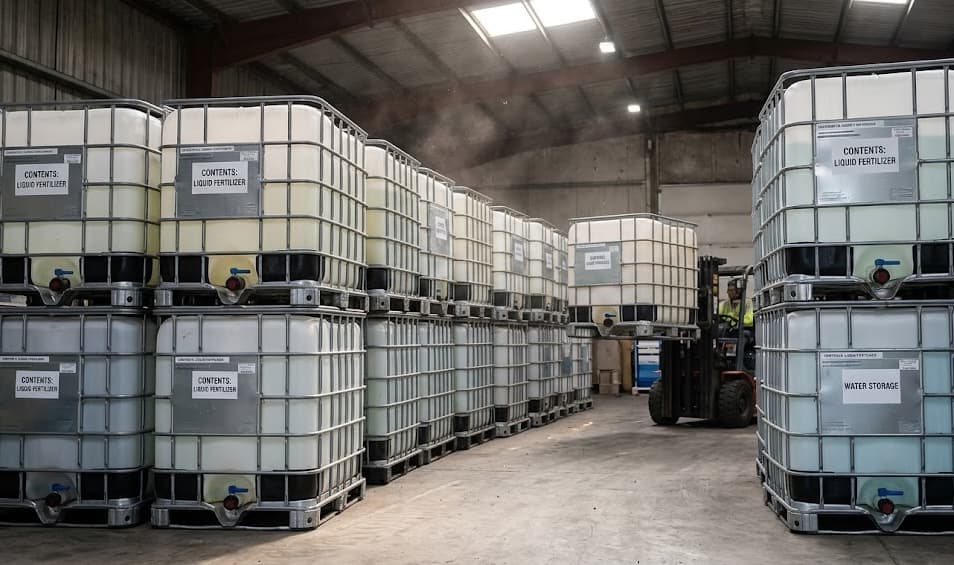
Inside our Minneapolis reconditioning facility — labeled IBC totes organized in rows as they move through the multi-step reconditioning process.
Why pay more for a reconditioned tote instead of buying raw used? Because the reconditioning process eliminates the unknowns and delivers predictable, reliable performance.
Unlike raw used totes where condition varies from unit to unit, reconditioned totes come off the line at a uniform standard. When you order 20 reconditioned totes, all 20 arrive in the same clean, tested, ready-to-use condition.
The components most likely to fail on a used tote are the valve and gaskets. On a reconditioned unit, these are brand new. You get the reliability of new parts where it counts most, at the points where your liquid enters and exits.
Every reconditioned tote passes a hydrostatic pressure test. This is not a visual once-over. It is a measured, documented verification that the container holds liquid under pressure without any leakage.
The triple-rinse process removes residual product, odor, and film from the HDPE bottle. You receive a tote with a clean interior that is ready for your product without additional preparation on your end.
Each tote comes with a reconditioning record that includes the date, prior-use grade, test results, and tracking number. This makes it easy to satisfy internal quality standards and regulatory audit requirements.
Reconditioned totes cost more than raw used totes but significantly less than buying new. You get near-new performance and reliability at a fraction of the new-purchase price, typically saving 30-50%.
Both options save you money compared to buying new. The right choice depends on your application, budget, and quality requirements.
| Factor | Used (As-Is) | Reconditioned |
|---|---|---|
| Price | Lowest cost per unit | Moderate, still well below new |
| Cleanliness | Rinsed, may have residual staining | Triple-rinsed, interior inspected |
| Valve Condition | Original valve, tested for function | Brand-new valve installed |
| Leak Guarantee | Visual check and valve test | Hydrostatic pressure test documented |
| Cosmetic Consistency | Varies unit to unit | Uniform appearance across order |
| Documentation | Grade label only | Full reconditioning record with tracking |
| Best For | Bulk storage, agriculture, rain collection, utility use | Food-adjacent, quality-sensitive, regulatory-audited applications |
| Typical Savings vs. New | 40-70% | 30-50% |
If your stored product could be affected by residual contamination from a prior use, reconditioned is the safe choice. The triple-rinse and interior inspection ensure the bottle is clean and free of residue.
When outfitting a new operation or replacing an entire fleet of containers, reconditioned totes arrive in consistent condition. This simplifies your receiving process and sets a baseline for your team.
Food manufacturing, pharmaceutical, and chemical companies often require documented cleaning and testing records. Our reconditioning documentation provides the paper trail auditors need to see.
If you are connecting the IBC to a process line, pump, or gravity-feed system, a brand-new valve eliminates the risk of drips, stiffness, or failure that can come with an older valve.
Customer-facing operations, trade shows, and demonstration setups benefit from a tote that looks clean and professional rather than visibly used. Reconditioned totes are presentable out of the box.
The pressure test, new gaskets, and documentation collectively remove uncertainty. You know the tote holds, the seals are fresh, and there is a record proving it. That confidence has real value.
Customize your reconditioned tote order to match your exact needs.
These two terms are often used interchangeably, but they describe fundamentally different processes. Understanding the distinction helps you make a more informed purchasing decision based on your actual requirements.
Reconditioning preserves the original HDPE bottle and restores it to a serviceable condition. The bottle is thoroughly cleaned, inspected, and pressure-tested. Wear items like valves, gaskets, and caps are replaced. The cage is repaired and treated. The result is the same physical container, professionally restored and documented.
Rebottling replaces the entire HDPE inner bottle with a brand-new one while retaining the original steel cage and pallet base. The old bottle is removed, recycled, and a factory-new HDPE bottle is installed into the existing cage. New valves, caps, and gaskets are installed as part of the process. The result is functionally a new IBC tote at roughly 60-70% of the new-purchase cost.
For the vast majority of customers, reconditioning delivers the best balance of cost, quality, and turnaround time. Choose rebottling when you specifically need a virgin HDPE bottle for food-contact certification, pharmaceutical compliance, or UN transport re-certification. We offer both services and can advise you on which option makes sense for your specific application during your consultation.
We track every aspect of our reconditioning process with measurable data. Here are the real numbers from our Minneapolis facility that demonstrate the consistency and reliability of our reconditioned IBC totes.
Percentage of totes entering our reconditioning line that pass all quality checkpoints on the first attempt without rework.
Less than one in two hundred reconditioned totes is returned for any reason. Most returns are related to order specification changes, not quality defects.
Every single reconditioned tote undergoes a hydrostatic pressure test. There are zero exceptions. If a tote cannot be pressure-tested, it is not sold as reconditioned.
Average time from intake to completed reconditioning is 48 hours. Rush reconditioning is available with same-day or next-day completion for time-sensitive orders.
Approximately 2.7% of totes that enter our reconditioning line are rejected and diverted to recycling. The most common rejection reasons are:
We analyze every rejection and every customer return to identify patterns and improve our process. Recent improvements based on quality data include:
A reconditioned IBC tote is not a temporary fix. With proper care, it delivers years of reliable service. Here is what determines how long your reconditioned tote will last and how to maximize its lifespan.
Protected from UV, minimal temperature cycling
Frequent cleaning cycles gradually wear the bottle
UV cover extends life dramatically over unprotected outdoor use
Direct sunlight is the primary life-limiting factor for HDPE
Low chemical stress; UV exposure is the main variable
Exposure to weather, fertilizers, and rough handling
The single most effective thing you can do for an outdoor tote. A $30 cover can add 3-5 years of service life by blocking the UV radiation that causes HDPE to become brittle and crack.
Uneven surfaces cause stress concentrations in the bottle and cage, leading to premature cracking and deformation. A concrete pad or compacted gravel is ideal.
Do not fill a cold tote with very hot liquid, or vice versa. Gradual temperature changes prevent stress cracking in the HDPE. Let the tote acclimate to ambient temperature before filling with temperature-extreme contents.
Even if they are not leaking, gaskets compress and harden over time. An annual gasket replacement on the cap and valve maintains seal integrity and prevents slow leaks that can develop gradually.
An open valve invites contamination from insects, dust, and debris. It also exposes the valve internals to UV degradation. Keep it closed and capped when not in active use.
A quick visual inspection of the bottle for cracks, the cage for rust or bending, and the valve for drips catches small issues before they become failures. Five minutes of inspection prevents days of downtime.
Every reconditioned IBC tote from our facility comes with a comprehensive documentation package. This paperwork is not just a formality. It provides the traceability and verification that quality-conscious operations and regulatory auditors require.
A signed and dated certificate confirming that the tote has completed our full 8-step reconditioning process. Includes the reconditioning date, the name of the facility, and the process standard followed. This certificate is the primary document for quality audits and regulatory inspections.
A documented record of the hydrostatic pressure test performed on the tote. Includes the test pressure applied, the hold duration, the result (pass/fail), and the date and operator initials. This report verifies that the container holds liquid under pressure without any leakage or deformation.
Details the cleaning process applied to the tote, including the cleaning agents used, water temperatures, rinse cycle count, and a final cleanliness assessment. For food-grade totes, the wash certificate confirms that only food-safe cleaning agents were used throughout the process.
Documents the previously stored contents based on original labeling and shipper records. This is critical for downstream chemical compatibility decisions. Knowing that a tote previously held orange juice concentrate versus industrial detergent determines its suitability for your specific product.
Every reconditioned tote is assigned a unique alphanumeric tracking number that links back to its complete reconditioning record in our system. If you ever have a question about a specific tote, this number lets us pull up its full history including original manufacturer, age, prior use, and every step of the reconditioning process.
A list of every component replaced during reconditioning, including valve type and manufacturer, gasket material, cap type, and any cage components that were repaired or replaced. This log ensures complete transparency about what is new and what is original on your reconditioned tote.
Our standard reconditioning process covers the essentials. But we also offer customization options that let you tailor the reconditioned tote to your exact specifications. Here are eight upgrades available during the reconditioning process.
Choose between a 2-inch polypropylene ball valve, a 2-inch PVDF ball valve for aggressive chemicals, a stainless steel ball valve for food-grade applications, or a butterfly valve for high-flow gravity dispensing. We can also install cam lock adapters, garden hose adapters, or custom thread sizes directly during reconditioning so your tote arrives ready to connect.
We remove all original labels and apply your custom labels during reconditioning. Provide your product name, lot codes, safety data, handling instructions, or company branding, and we apply durable weatherproof labels to the cage in your specified positions. This is especially popular for companies maintaining a fleet of totes that need consistent identification.
Assign different cap colors to different product types for instant visual identification. Red caps for chemicals, blue for water, green for food-grade contents, yellow for waste, and so on. We stock caps in eight standard colors and can order specialty colors for large orders. Color coding reduces cross-contamination risk and speeds up operations in multi-product environments.
Standard EPDM gaskets work for most applications, but some chemicals require different materials. We offer Viton gaskets for fuels, solvents, and aggressive chemicals. PTFE-encapsulated gaskets for pharmaceutical and ultra-pure applications. Silicone gaskets for high-temperature service. The right gasket material prevents premature degradation and ensures a long-lasting seal with your specific product.
The standard reconditioning process treats rust and restores the galvanized cage to a presentable condition. As an upgrade, we can fully repaint the cage in any RAL color for brand consistency, safety coding, or aesthetic preference. We use industrial-grade enamel that resists chipping, UV fading, and chemical splash. Popular for customer-facing installations and brand-conscious operations.
If the original pallet base is damaged, warped, or the wrong type for your application, we can swap it during reconditioning. Options include steel pallets for maximum durability and stacking strength, HDPE plastic pallets for chemical resistance and weight savings, wood pallets for cost savings, and composite pallets that balance strength and weight. Pallet replacement ensures your tote sits flat, stacks safely, and meets your facility requirements.
For applications requiring an extra barrier between the product and the HDPE bottle, we install disposable polyethylene liners during reconditioning. Liners are available in standard polyethylene for general use, food-grade polyethylene for consumables, and anti-static polyethylene for flammable liquids. A liner turns any reconditioned tote into a clean, single-use vessel while still allowing the tote itself to be reused indefinitely.
For operations in cold climates that plan to add electric heat tracing to the tote, we can pre-install mounting clips, insulation standoffs, and thermostat probe fittings during reconditioning. This preparation work saves significant time and labor in the field. We route the heat trace channel along the optimal path from the valve up the bottle sidewall to prevent dead spots and ensure even heating.
Ever wondered what happens to an IBC tote after its last use? Follow the complete recycling journey from collection to material recovery and learn how each component of an IBC gets a second life.
Not sure if your IBC tote is still safe to use? Learn the seven critical warning signs that indicate an IBC has reached the end of its useful life and whether repair or full replacement is the right call.
Choosing between IBC totes and steel drums? This detailed comparison covers capacity, cost per gallon, space efficiency, ease of use, and the specific scenarios where each container type comes out ahead.
Contact us for pricing on reconditioned IBC totes. We offer volume discounts, delivery throughout the Minneapolis metro area, and can customize valve types and add-ons to your specification.