IBC
Visit
3312 Broadway St NE
Minneapolis, MN 55413
Our own fleet handles every delivery — no third-party carriers, no finger-pointing when something goes wrong. Same-day metro delivery for orders placed before noon. Regional shipping throughout the Upper Midwest on our flatbed and enclosed trucks.
We operate our own trucks out of Minneapolis. Lead times shown are for in-stock totes; custom orders may take additional time.
Free delivery on orders of 4+ totes. Covers Minneapolis, St. Paul, Bloomington, Plymouth, Maple Grove, Eagan, Woodbury, Brooklyn Park, and surrounding suburbs within a 30-mile radius of downtown Minneapolis.
Stillwater, Hastings, Chaska, Elk River, Forest Lake, and surrounding areas. Delivery fee applies for loads under 10 totes.
Rochester, Duluth, St. Cloud, Mankato, and anywhere in Minnesota. Full-truckload orders ship direct; smaller loads consolidated on weekly routes.
Wisconsin, Iowa, North Dakota, South Dakota. Common lane freight rates available. Full-truckload preferred for cost efficiency.
Right-sized equipment for every order, from a single tote to a full truckload.
Local and metro deliveries. Open access for forklift loading from any side. Ideal for job sites and facilities without docks.
Full-truckload regional shipments. Most cost-effective option for large orders. Totes are strapped and blocked per DOT load securement standards (FMCSA 393.100).
Weather-sensitive deliveries and food-grade totes that need protection from road contamination during transit. Liftgate equipped for ground-level delivery.
Small orders, urgent same-day deliveries, and customer pickups from our yard. We load with forklift at no charge.
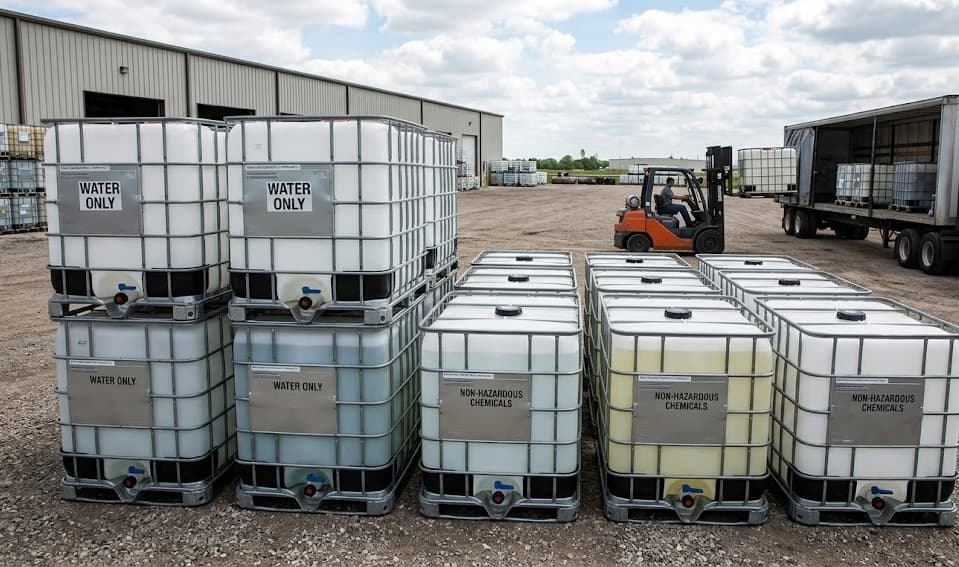
Loading IBC totes for delivery — our forklift operators follow strict handling protocols to ensure every tote arrives at your facility in perfect condition.
IBC totes are designed to be double-stacked when empty and properly aligned. Our drivers are trained on correct IBC handling procedures — not general freight procedures adapted for totes, but specific IBC protocols developed over years of handling thousands of containers.
On flatbeds, empty totes are double-stacked with the upper tote's pallet runners seated fully inside the cage perimeter of the lower tote. Each column is strapped independently to the bed with ratchet straps rated at 5,000 lbs working load limit. Edge protectors prevent strap damage to the cage. The front row is blocked against the headboard.
Filled or partially filled totes are never stacked. They are transported in single-layer configuration with valve-side facing inboard to prevent accidental discharge. Hazmat loads travel with the appropriate placards and documentation per DOT 49 CFR requirements.
Transport pricing depends on three factors: distance, quantity, and whether the totes are empty or filled. We structure pricing to reward consolidation — the more totes per trip, the lower the per-unit delivery cost.
For metro Minneapolis deliveries, orders of 4 or more empty totes ship free when purchased from our inventory. Delivery-only services (transporting your totes from one location to another) are quoted based on the number of stops and total tote count.
Regional full-truckload rates are competitive with common carrier freight because we eliminate the broker margin and run our own equipment. We quote flat rates per load, not per mile, so you know the total cost before we dispatch. No fuel surcharges, no accessorial fees, no surprises on the invoice.
4+ totes purchased, Minneapolis/St. Paul metro
1–3 totes, metro area — flat rate applies
Consolidated weekly routes, per-tote pricing
48 totes, flat rate per load, most economical
Filled totes with hazmat classification, quoted per job
Orders after noon cutoff, priority dispatch fee
Whether we are picking up your totes or you are bringing them to our yard, a few minutes of preparation ensures safe handling and prevents delays.
Open the bottom valve and let the tote drain fully. Even a few gallons of residual liquid shifts the center of gravity during stacking and creates a spill risk. If the tote contained hazardous materials, capture the residual in an appropriate container — do not pour on the ground.
Hand-tighten the bottom discharge valve and install the dust cap. Close and cap the top fill port. This prevents road debris from entering the bottle and keeps valves from snagging during loading.
Place totes on a flat, firm surface accessible by forklift. Gravel or uneven ground makes forklift operation unsafe. If your facility only has uneven staging areas, let us know in advance — we can bring equipment to compensate.
Our trucks need at least 12 feet of width and 14 feet of overhead clearance. For flatbed loading, we need 60+ feet of straight-line space to position the trailer. Ensure the route from staging area to truck access point is free of obstructions.
If the tote last held a DOT-regulated material, ensure the original hazmat label is visible or provide a shipping name and UN number. This determines our transport requirements and placarding. Unlabeled hazmat totes cannot be transported until identified.
Five vehicle classes in our fleet, each purpose-matched to specific IBC transport scenarios. Every vehicle is company-owned, DOT-inspected, and operated by our trained drivers.
Specs: Deck length 26 ft, deck width 102 inches, aluminum deck with stake pockets every 24 inches, rub rail on both sides, 5,000 lb winch, 20 ratchet straps rated at 5,000 lb WLL each. No CDL required for our drivers under 26,001 lb GVWR — this means faster dispatch with no HOS log restrictions for local routes.
Best for: Metro and near-metro deliveries where forklift access from the side is needed. Job sites, warehouse yards, and facilities without loading docks. Our most-deployed vehicle for daily metro runs.
Specs: Standard 53-ft aluminum flatbed with spread axle, air ride suspension, sliding tandems for weight distribution. Deck is rated to 48,000 lbs. Equipped with 4-inch edge protectors, 50 ratchet straps, and coil racks for mixed loads. Headboard rated to 40% of payload. All strapping meets FMCSA 393.100 aggregate working load limit requirements.
Best for: Full truckload shipments — regional or nationwide. The most economical per-unit cost for orders of 48 totes. Also used for large recycling pickups and facility cleanout projects where dozens or hundreds of totes need to move in a single trip.
Specs: Insulated aluminum box body, rear roll-up door with Waltco 3,300 lb liftgate, interior E-track rails on both walls for strap anchoring, LED interior lighting, dock-height rear bumper (48 inches). Box interior dimensions: 26 ft L x 96 in W x 96 in H. Climate protection for temperature-sensitive deliveries.
Best for: Food-grade tote deliveries requiring contamination protection during transit. Deliveries to facilities with no forklift or dock — the liftgate lowers totes to ground level. Bad-weather deliveries when rain, snow, or road salt would contaminate open-top or cleaned totes.
Specs: 12-ft stake body with removable side panels, 4,500 lb liftgate, low deck height (30 inches) for easy loading. Compact enough to navigate tight urban alleys, parking garages, and residential driveways. Equipped with a 5,000 lb receiver hitch for towing additional trailer capacity when needed.
Best for: Small to mid-size deliveries in congested urban areas. Ideal for downtown Minneapolis, university campuses, and tight industrial parks where a full-size truck cannot maneuver. Also our go-to vehicle for single-tote rush deliveries.
Specs: Heavy-duty 3/4-ton pickup with 16-ft tandem axle trailer rated to 7,000 lbs. Trailer has 2-ft side rails, rear ramp gate, and tie-down D-rings every 2 feet. Pickup bed carries tools, straps, and edge protectors. Combined unit length under 40 feet for easy maneuvering.
Best for: Urgent same-day deliveries of 1–4 totes. Customer yard pickups where a larger truck is not needed or cannot access. Also used for customers who want to pick up totes from our yard with our assistance — we load with our forklift and the customer drives the trailer to their site.
Our delivery network radiates outward from our Minneapolis base in four concentric service zones, each with different lead times and pricing structures. The closer you are to Minneapolis, the faster and more economical your delivery. But we reach coast-to-coast through our carrier partnership network when needed.
Within the Twin Cities metro, we run daily routes that cover every suburb and industrial park. Our drivers know the loading docks at hundreds of local facilities and can navigate to your specific bay without wasting time. Same-day delivery is standard for in-stock orders placed before noon — not a premium service, just how we operate.
For regional destinations, we run consolidated routes on set days: Rochester corridor on Tuesdays, St. Cloud and Duluth on Wednesdays, and western Minnesota and the Dakotas on Thursdays. Full truckload orders ship direct on any day with 1–2 days advance notice. Nationwide shipments are coordinated with vetted flatbed carriers who meet our insurance and safety requirements.
0–30 miles from Minneapolis
Minneapolis, St. Paul, Bloomington, Plymouth, Maple Grove, Eagan, Woodbury, Brooklyn Park, Burnsville, Eden Prairie, Minnetonka, Shakopee, Coon Rapids, and all inner-ring suburbs.
30–150 miles
St. Cloud, Rochester, Mankato, Faribault, Red Wing, Willmar, Hutchinson, Elk River, Cambridge, and surrounding communities. Consolidated weekly routes keep costs low.
150–500 miles
Duluth, Fargo, Sioux Falls, Des Moines, La Crosse, Eau Claire, Green Bay, Milwaukee, and Omaha corridors. Full truckload preferred for cost efficiency; LTL available.
500+ miles
Anywhere in the continental U.S. via partner carriers. Common lanes include Chicago, Denver, Kansas City, St. Louis, and Dallas. Full truckload shipments only for cost-effective long-haul.
Transporting IBCs that contain or previously contained hazardous materials triggers a comprehensive set of DOT regulations under 49 CFR Parts 171–180. Non-compliance carries penalties up to $80,000 per violation and personal criminal liability for the shipper. We handle all compliance requirements so you do not have to navigate these regulations yourself.
Our drivers hold current hazmat endorsements (H endorsement on CDL) and have completed the required DOT hazmat training per 49 CFR 172.704, including general awareness, function-specific, safety, and security training modules. Training is refreshed every three years with documentation maintained in our files and available for shipper inspection upon request.
Before any hazmat transport, we verify proper packaging (the IBC must be UN-rated and within its retest period), confirm the correct shipping name and UN number, prepare shipping papers per 49 CFR 172.202, and apply the required placards to the transport vehicle per 49 CFR 172.504. For residue-only shipments (IBCs that have been emptied but not cleaned), we follow the residue placarding and documentation rules in 49 CFR 173.29. All paperwork is retained for two years as required by DOT record-keeping regulations.
Twelve rules our drivers follow on every load. These practices prevent cargo damage, protect road safety, and ensure your totes arrive in the same condition they left.
Every tote is visually checked for cracks, leaks, and loose valves before it goes on the truck. Damaged totes are flagged and segregated — they are not loaded until the shipper approves.
Forklifts approach from the pallet entry sides only — never from the bottle side. Fork tines from the wrong direction puncture the HDPE bottle or collapse the cage inward.
Fork tines are inserted fully through the pallet before lifting. Partial insertion causes the tote to tip backward off the forks during elevation — a leading cause of IBC damage and operator injury.
Only empty, structurally sound totes are double-stacked. The upper tote's pallet runners must seat fully inside the cage perimeter of the lower tote. Filled or partially filled totes are never stacked under any circumstances.
Each column of stacked totes is secured independently with a minimum of two ratchet straps rated at 5,000 lb WLL. Straps cross over the top of the upper tote and anchor to the trailer bed on each side.
Plastic or cardboard edge protectors are placed at every point where a strap contacts the cage. This prevents the strap from cutting into the cage tubing and creating a weak point that causes cage failure under load.
The first row of totes is positioned tight against the trailer headboard to prevent forward shift during braking. If the front row does not make full headboard contact, dunnage or blocking lumber fills the gap.
Filled totes are oriented with the bottom discharge valve facing inboard (toward the trailer centerline), not outboard. This prevents accidental valve contact with dock structures, overhead obstructions, or roadside objects during transit.
A filled tote weighs 2,300+ lbs. An empty tote weighs approximately 200 lbs. Stacking a filled tote on an empty one would crush the lower cage. We never mix filled and empty in the same stack — period.
Every bottom valve gets a dust cap hand-tightened before transport. Every top fill port gets its cap secured. This prevents debris entry, eliminates drip risk from residual liquid, and keeps valve handles from snagging during loading.
Our drivers photograph every completed load from the front, rear, and both sides before departure. Photos are timestamped and stored in our dispatch system. If a damage claim arises, we have visual proof of load condition at origin.
For semi-trailer loads, we verify axle weight distribution using portable scales or CAT scale tickets. Overloaded axles are illegal, damage roads, and increase stopping distance. We redistribute totes on the trailer if axle weights are not within DOT limits.
Every IBC we transport is covered by our commercial auto and cargo insurance policies from the moment it is loaded onto our vehicle until it is unloaded at the destination. We carry $1 million in commercial auto liability, $250,000 in cargo insurance per load, and $2 million in general commercial liability coverage. Certificates of insurance are available upon request and can be issued with your company listed as additionally insured.
If a tote is damaged during our transport, we replace it at no charge from our inventory or reimburse you for the documented value — whichever you prefer. Damage claims are resolved within 5 business days. We photograph every load before departure and upon delivery, so there is never ambiguity about when damage occurred. In over five years of operation, our cargo damage rate is below 0.3% of totes transported.
For high-value loads — filled totes containing expensive chemicals, food ingredients, or pharmaceutical products — we offer additional cargo insurance riders that cover the contents value, not just the container. These riders are quoted per-load based on declared value and can be bound same-day through our insurance broker.
Minnesota's extreme seasonal swings create unique challenges for IBC transport. Here is how we manage each season to ensure safe, on-time delivery year-round.
Key answers about delivery areas, same-day scheduling, loading requirements, and how our transport service fits with the rest of the IBC workflow.
We serve Minneapolis, Saint Paul, the broader Twin Cities metro, greater Minnesota, and selected Upper Midwest lanes. Service timing depends on route density, order size, and whether the shipment is local, regional, or full-truckload.
Yes. We move both empty and filled totes, but the loading pattern, stacking rules, and documentation requirements are different. Filled totes are handled with tighter securement and single-layer transport practices, especially when regulated contents are involved.
Yes, for certain in-stock orders and metro routes. Same-day availability depends on cutoff time, tote count, truck availability, and whether the order needs special prep such as cleaning or weather-sensitive enclosed transport.
Make sure totes are drained as required, capped, staged on stable ground, and accessible for forklift or truck positioning. If the containers last held hazardous material, provide the necessary identification details before pickup so we can dispatch the job correctly.
Yes. Transport is often bundled with tote purchases, returns from cleaning, or recycling pickups. We can sequence those services so containers move through the right workflow without requiring the customer to coordinate multiple vendors.
Proper stacking and storage of IBC totes is essential for safety and space optimization. This guide covers maximum stacking heights, weight considerations, surface requirements, forklift procedures, and fire code compliance for both indoor and outdoor storage.
Minnesota winters bring temperatures as low as -30F, posing serious risks to IBC totes stored outdoors. This guide covers everything you need to know about winterizing, insulating, and protecting your IBCs during the harsh cold season.