IBC
Visit
3312 Broadway St NE
Minneapolis, MN 55413
Every IBC tote is 200+ pounds of recoverable material. We break them down to their components, process each material stream responsibly, and provide documentation to prove it. Nothing we touch goes to landfill.
An estimated 800,000 IBC totes reach end-of-life in the United States each year. Many end up in landfills because businesses do not realize the materials are highly recyclable — or because separating a composite container into its plastic, metal, and wood components is not something a standard waste hauler will do.
A single IBC tote occupying landfill space takes up approximately 48 cubic feet. The HDPE bottle alone will persist in a landfill for an estimated 400+ years. The steel cage, while eventually degradable, leaches zinc and other coating materials into soil and groundwater during its decades-long decomposition.
Proper recycling eliminates this entirely. Every component has a buyer, every material has a second life, and the economics work — which is why we offer free pickup for recycling loads of 10 or more totes in the Twin Cities metro.
Five documented steps from intake to certificate. Full chain of custody at every stage.
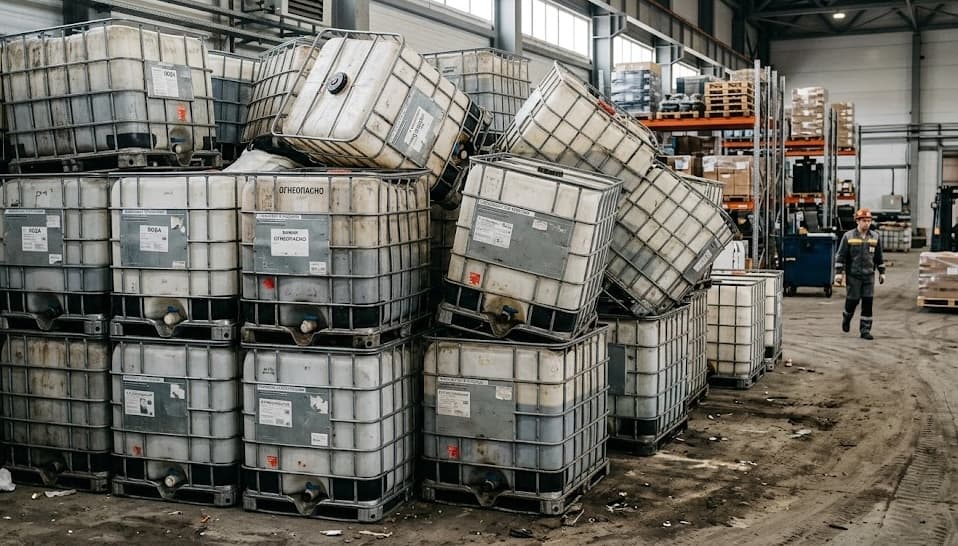
Our recycling processing area — end-of-life IBC totes are stacked and staged for disassembly, with HDPE, steel, and wood separated into dedicated material streams.
We pick up end-of-life totes from your facility or accept drop-offs at our Minneapolis yard. Every incoming tote is logged with a unique tracking ID, photographed, and assessed. Previous contents are recorded to determine the correct handling protocol — food-grade containers follow a different stream than those that held solvents or agricultural chemicals.
Residual liquids are drained into designated containment. Totes that held hazardous materials undergo neutralization in compliance with MPCA and EPA regulations. Non-hazardous residues are captured and disposed of through licensed waste haulers. The tote is then rinsed and prepped for disassembly.
The IBC is broken down into its three primary components: the HDPE blow-molded bottle (approximately 130 lbs of high-density polyethylene), the galvanized or powder-coated steel cage (approximately 70 lbs of tubular steel), and the wood or composite pallet base. Each material enters its own processing stream.
HDPE bottles are granulated on-site into regrind flake and baled for shipment to resin processors who turn them into pellets for new plastic products. Steel cages are compressed and sent to regional scrap metal facilities for melting and re-forming. Wood pallets in good condition are repaired and reused; damaged wood is chipped for mulch or biomass fuel.
You receive a Recycling Certificate documenting the tote tracking IDs, materials recovered, processing methods, and downstream destinations. This documentation supports your sustainability reporting, ISO 14001 compliance, and corporate environmental commitments.
Real metrics from our recycling operations, not marketing estimates.
Each recycled IBC bottle yields roughly 130 pounds of high-density polyethylene regrind — enough to manufacture approximately 5,000 new plastic bottles or 65 pounds of drainage pipe.
The galvanized steel cage from each IBC recovers about 70 pounds of recyclable steel. Steel is infinitely recyclable without quality degradation, making cage recycling one of the highest-value recovery streams.
Our zero-landfill commitment means every gram of material is either reused, recycled, or converted to energy. Even valve gaskets and label adhesives are accounted for in our waste stream.
Recycling an IBC tote produces roughly 82% fewer carbon emissions compared to manufacturing an equivalent container from virgin materials, when accounting for resin production, steel smelting, and transportation.
We partner with licensed recycling facilities throughout Minnesota to keep materials in the regional circular economy. Our HDPE regrind goes to processors within 200 miles of Minneapolis. Steel is handled by Twin Cities scrap operations. Wood waste is processed by local biomass and mulch producers.
This localized approach minimizes transportation emissions and supports the regional recycling infrastructure that makes programs like ours viable long-term. When you recycle with us, the economic benefit stays in Minnesota.
We maintain documentation on all downstream partners, including their permits, processing methods, and environmental certifications. This information is available upon request and is included in our detailed recycling reports for enterprise clients.
Every recycling job generates a formal Recycling Certificate that documents the materials processed, quantities recovered, and final disposition of all components. These certificates are issued within 5 business days of processing completion and delivered as signed PDF documents.
For businesses with sustainability reporting requirements, ESG commitments, or ISO 14001 environmental management systems, our certificates provide the third-party documentation needed to substantiate waste diversion claims. We also provide annual summary reports for repeat clients, aggregating all recycling activity for the calendar year.
We track recovery efficiency for every material stream in our recycling operation. These are actual measured rates from our facility, not industry averages or theoretical maximums.
The blow-molded polyethylene bottle is granulated into regrind flake with minimal material loss. The 0.8% loss comes from fine dust generated during granulation, label adhesive residue captured in wash water, and small sections removed during quality cuts around stress cracks or UV-degraded zones. Our inline magnetic and air separation systems capture 99.2% of processable HDPE by weight.
Galvanized and powder-coated tubular steel cages are compressed into bales with near-zero material loss. The 0.2% loss is attributable to zinc dust and paint flakes shed during compression, which are captured in our containment system and disposed of as industrial waste. Steel is infinitely recyclable — our cage steel returns to service as rebar, structural channel, or new tubing.
Wood pallets in serviceable condition are repaired and returned to the pallet supply chain. Pallets too damaged for repair are chipped for landscape mulch or biomass fuel. The 8% loss accounts for moisture evaporation during chipping, sawdust lost in processing, and small fastener-contaminated wood fragments that are separated and landfilled per MPCA guidelines.
Polypropylene valve bodies, butterfly handles, and cam-lock adapters are sorted by polymer type and processed with our plastics stream. Metal fittings (brass, stainless) go to scrap metal. The 5% loss consists of composite gaskets (rubber bonded to metal) that cannot be economically separated and are sent to waste-to-energy facilities.
All product labels, hazmat placards, and adhesive residues are stripped during the decontamination phase. Paper and vinyl labels are captured in our wash water filtration system and sent to waste-to-energy. Adhesive residue is dissolved with citrus-based solvents and filtered from rinse water. No label material remains on any recycled component.
EPDM and Viton gaskets are sorted by elastomer type. EPDM gaskets are ground into crumb rubber for use in athletic surfaces and playground material. Viton gaskets, which are more chemically resistant, are sent to specialty recyclers. The 12% loss represents gaskets too degraded or contaminated for recycling, which go to waste-to-energy.
We trace every material from the moment it leaves our facility to its next life. Here is the complete downstream journey for each IBC component.
The polyethylene bottle is shredded into flake, washed to remove contaminants, dried, and baled at our facility. Baled regrind ships to regional resin processors within 200 miles of Minneapolis who melt the flake into pellets. Those pellets are sold to manufacturers who produce drainage pipe, automotive fuel tanks, plastic lumber, non-food containers, agricultural drainage tile, and industrial pallets. A single IBC bottle yields enough HDPE to manufacture approximately 40 feet of 4-inch corrugated drainage pipe or 130 plastic landscape stakes. Our HDPE regrind consistently tests at a melt flow index of 5–8 g/10min, making it suitable for blow molding and extrusion applications.
Compressed cage bales are transported to Twin Cities scrap metal facilities where they are fed into electric arc furnaces or shredded and magnetically sorted for smelting. The recycled steel returns to service as rebar for concrete reinforcement, structural steel beams, automotive components, appliance housings, and new wire products. Steel recycling requires 74% less energy than virgin steel production from iron ore. The zinc galvanizing on the cage is recovered during the smelting process and recycled into new galvanizing baths — nothing is wasted. A single IBC cage provides enough recycled steel for approximately 35 feet of #4 rebar.
Pallets in repairable condition are sent to pallet refurbishers who replace broken deck boards and runners, then return them to the pallet supply chain. A repaired pallet has an average remaining service life of 3–5 years and displaces the harvest of one tree per 8 pallets saved. Pallets beyond repair are processed through a tub grinder to produce wood chips. Clean chips become landscape mulch sold to garden centers and municipal landscaping operations. Chips from treated or contaminated wood are sent to biomass energy facilities where they are burned to generate electricity — one IBC pallet produces approximately 35 kWh of energy, enough to power a Minnesota home for over a day.
Polypropylene components (valve bodies, caps, handles) are collected, sorted by color and grade, and granulated into regrind. PP regrind is sold to injection molding operations that produce non-critical parts: storage bins, tool handles, automotive interior trim, and packaging components. Metal fittings — brass cam-lock adapters, stainless hose barbs, steel bolts — are sorted and sold to metal recyclers by alloy type. Small rubber gaskets are ground into crumb rubber. Every fitting is accounted for in our material tracking system to maintain our zero-landfill documentation.
We calculated the environmental footprint of recycling a single standard 275-gallon IBC tote versus manufacturing an equivalent new container from virgin materials. These figures are based on lifecycle assessment methodology using EPA WARM model data and our own operational measurements.
The savings are significant because IBC manufacturing is energy-intensive — blow-molding 130 lbs of HDPE requires petroleum feedstock extraction, polymerization, and high-temperature processing. Smelting 70 lbs of virgin steel for the cage requires iron ore mining, coal coking, and blast furnace operation. Recycling bypasses all of these upstream processes.
For businesses tracking Scope 3 emissions, recycling IBCs through our program generates documented offsets that can be applied to your supply chain carbon accounting. We provide the data in a format compatible with GHG Protocol and CDP reporting frameworks.
Compared to manufacturing equivalent new IBC from virgin materials
Primarily from avoided HDPE resin production and steel smelting cooling
Equivalent to 14.5 gallons of gasoline or 53 kWh of electricity
One tote footprint that would persist for 400+ years in a landfill
Crude oil equivalent that would be consumed producing virgin HDPE resin
Raw ore mining displaced by recycling the steel cage through scrap processing
IBCs that previously contained hazardous materials require specialized handling before they can be recycled. Under RCRA (Resource Conservation and Recovery Act) regulations, a container that held a listed or characteristic hazardous waste is itself a hazardous waste until it has been properly emptied and decontaminated per 40 CFR 261.7 — the "empty container" rule.
Our facility is permitted to receive and process IBCs that held RCRA-regulated materials. We follow the triple-rinse protocol specified in 40 CFR 261.7(b)(3) for containers under 110 gallons-equivalent, and the comparable large-container protocol for IBCs. Each rinse uses a solvent or cleaning agent appropriate for the specific contaminant, and all rinseate is captured, tested, and disposed of through licensed hazardous waste haulers.
After decontamination, we test the bottle material and rinse water to confirm contaminant levels are below RCRA characteristic thresholds (ignitability, corrosivity, reactivity, and toxicity via TCLP testing). Only after confirmed clean test results does the tote enter our standard recycling stream. All testing is performed by certified third-party laboratories, and results are included in your recycling documentation package.
Our Recycling Certificate is more than a receipt — it is a legally defensible document that proves your waste was diverted from landfill and processed through compliant, documented channels. In an era of increasing ESG scrutiny, greenwashing allegations, and regulatory audits, having proper recycling documentation is not optional — it is essential.
Each certificate includes a unique tracking number, the date range of processing, itemized material weights by type (HDPE, steel, wood, other), the specific downstream facility that received each material stream, the processing method used (granulation, smelting, chipping, etc.), and a signed zero-landfill compliance attestation. For hazmat totes, the certificate also references the decontamination protocol and attaches TCLP lab results.
For ESG reporting, our certificates align with the GRI 306 (Waste) standard and provide the data points needed for CDP climate and water disclosures. We format the data so it can be directly imported into common sustainability reporting platforms including Enablon, Sphera, and Benchmark ESG. Annual summary reports aggregate all recycling activity and calculate total CO2 avoided, water saved, and landfill space preserved — ready for inclusion in your annual sustainability report.
We retain copies of all certificates for a minimum of 7 years and can provide duplicates or verification letters upon request. Our documentation has been accepted by ISO 14001 auditors, state environmental agencies, and Fortune 500 corporate sustainability teams without modification.
Structured programs for businesses that generate ongoing IBC waste. Lock in service terms, simplify logistics, and streamline your environmental compliance.
Questions customers ask most often about pickup, compliance handling, certificates, and what happens after an IBC enters our recycling stream.
We log the tote, review its previous contents, drain residual material when needed, and separate the container into recoverable material streams such as HDPE, steel, and pallet components. Those materials then move into qualified downstream reuse or recycling channels.
Yes. We provide documentation that identifies the load, the materials recovered, and the processing path. That paperwork is useful for customers tracking waste diversion, sustainability metrics, or internal environmental compliance records.
Yes, but those containers require a more controlled intake and decontamination path. We review the prior contents, follow the necessary handling protocol, and only move the tote into standard recycling after the required steps are completed.
Yes. We offer local pickup for qualifying recycling loads and can also coordinate larger regional pickups. The exact schedule depends on tote count, access conditions, and whether the containers require special handling.
Reconditioning keeps the tote in service as a functional container, while recycling breaks it down into raw material streams when reuse is no longer the best option. We evaluate incoming totes to determine which path preserves the most value and keeps the most material out of landfill.
Ever wondered what happens to an IBC tote after its last use? Follow the complete recycling journey from collection to material recovery and learn how each component of an IBC gets a second life.
We have reached a major environmental milestone: 100 tons of plastic diverted from landfills through our IBC tote reuse and recycling program. Here is the story behind the numbers, how we calculated our impact, and what it means for our community.
From oil wells to factory floors, the production of new plastic containers carries a heavy environmental toll. This article examines the full lifecycle impact and makes the case for choosing reused IBC totes over new ones.
Totes too good for recycling? We may buy them for resale instead.
Salvageable totes get cleaned and returned to service.
We pick up recycling loads anywhere in the Twin Cities.
Before recycling, consider if a modification extends the tote's life.