IBC
Visit
3312 Broadway St NE
Minneapolis, MN 55413
Quality-inspected 275-gallon and 330-gallon used intermediate bulk containers. Every tote is graded, tested, and priced to save you 40-70% compared to buying new.
Intermediate Bulk Containers are engineered for repeated use. A single IBC tote is built from high-density polyethylene (HDPE) rated for years of service, housed inside a galvanized steel cage that protects it during transport and stacking. When a tote completes its first lifecycle in the food, beverage, or chemical supply chain, it still has the vast majority of its useful life ahead of it.
Buying used means you capture that remaining value at a fraction of the original cost. You get the same HDPE bottle, the same steel cage, the same 2-inch butterfly or ball valve, and the same forklift-compatible pallet base. The only difference is the price tag and a few cosmetic marks that have zero effect on performance.
At IBC Minneapolis, every used tote passes through our hands before it reaches yours. We inspect the cage for structural integrity, check the bottle for cracks and UV degradation, test the valve for proper operation, and verify that the pallet base is solid. If a tote does not meet our standards, it goes to our recycling stream instead of our sales floor.
A brand-new 275-gallon IBC tote typically runs between $250 and $400 depending on the manufacturer and specifications. Our used totes start at a fraction of that price, giving you significant savings per unit. When you are buying 10, 50, or 100+ totes for an operation, that difference translates into thousands of dollars back in your budget.
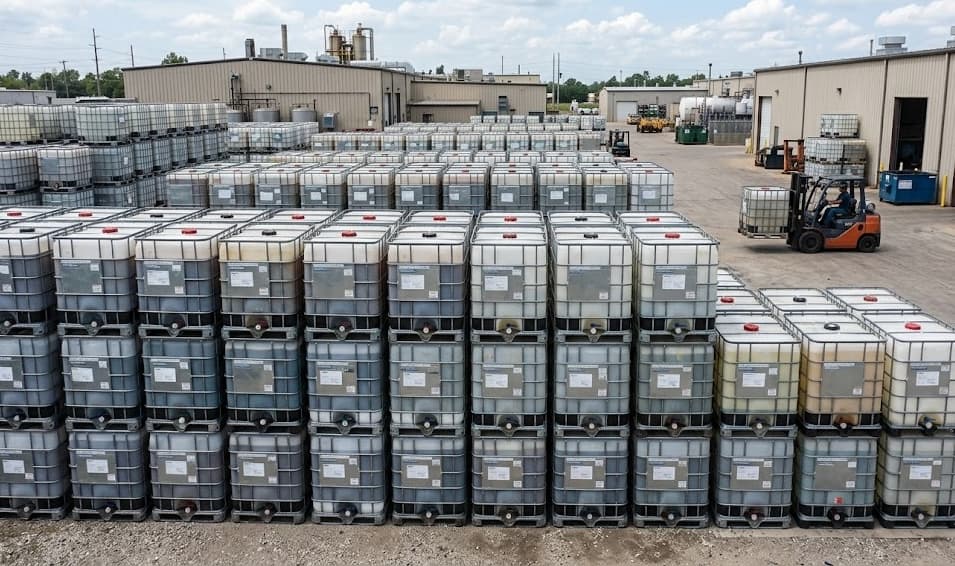
Our outdoor inventory yard in Minneapolis — hundreds of inspected IBC totes organized by grade and size, ready for same-day pickup or delivery.
We stock both standard IBC tote sizes. Both feature HDPE inner bottles, galvanized steel cages, and integrated pallet bases compatible with forklifts and pallet jacks.
The industry standard. The 275-gallon (1,041-liter) IBC tote is the most widely available size in North America. It fits neatly on a standard 48" x 40" pallet, slides into the back of a pickup truck, and stacks up to three high when full. This is the go-to choice for the majority of storage, transport, and processing applications.
| Capacity | 275 gallons / 1,041 liters |
| Dimensions (L x W x H) | 48" x 40" x 46" |
| Tare Weight | ~120 lbs |
| Filled Weight | ~2,415 lbs |
| Valve Size | 2" butterfly or ball |
| Fill Opening | 6" / 150mm screw cap |
The 330-gallon (1,249-liter) IBC tote offers 20% more capacity on the same footprint by extending the height. This size is preferred when you need to maximize volume per pallet position in warehouse storage, reduce the number of containers in a batch process, or simply get more product per shipment. Slightly less common on the secondary market, but we maintain consistent stock.
| Capacity | 330 gallons / 1,249 liters |
| Dimensions (L x W x H) | 48" x 40" x 53" |
| Tare Weight | ~135 lbs |
| Filled Weight | ~2,887 lbs |
| Valve Size | 2" butterfly or ball |
| Fill Opening | 6" / 150mm screw cap |
Not all used IBC totes are created equal. The contents previously stored in a tote determine what it can safely be used for in its second life. We categorize our inventory by prior-use grade so you can choose confidently.
Previously held food-safe liquids such as juice concentrates, syrups, cooking oils, vinegars, wine, or food-grade glycerin. These totes meet FDA and USDA standards for food-contact materials and are the best choice when your stored liquid may come into contact with consumable products.
Best for: Beverage production, food processing water supply, maple syrup storage, hydroponic nutrient solutions, potable water backup systems.
Previously contained non-hazardous industrial liquids such as detergents, surfactants, water-based paints, lubricants, or coolants. These totes are thoroughly cleaned and are suitable for the widest range of secondary applications where food-contact certification is not required.
Best for: Parts washing, coolant storage, irrigation water, construction site water supply, pressure washer reservoirs, dust suppression.
Previously held non-food chemicals such as solvents, acids, alkalis, or specialty chemical products. These totes are priced lower and are appropriate for applications where the stored material is itself a chemical or where trace contamination is not a concern.
Best for: Chemical storage and transport, waste collection, non-critical bulk liquid storage, secondary containment reservoirs.
Beyond the grade (what was stored), we rate every tote on its physical condition. This tells you what the tote looks like and how much wear it has experienced, regardless of its prior contents.
Minimal cosmetic wear. Cage is straight with no significant dents. Bottle is clean with little to no staining. Valve operates smoothly. Ideal for food-adjacent and clean storage applications.
Moderate cosmetic wear including minor cage dents and light bottle discoloration. Fully functional with no leaks. Suitable for most industrial, agricultural, and non-potable water storage uses.
Noticeable cosmetic wear, possible cage bending, and visible bottle staining. Structurally sound and leak-free. Best for non-critical storage, rainwater collection, and general utility use.
Every used IBC tote that enters our Minneapolis facility goes through a standardized inspection before being listed for sale. Here is exactly what we check.
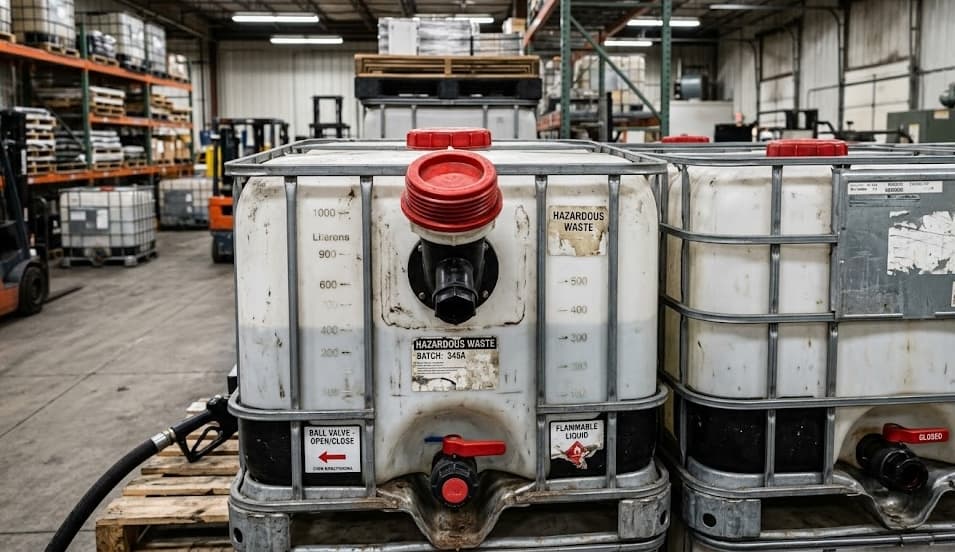
Close-up detail of an IBC tote during inspection — red fill cap, discharge valve, cage structure, and condition markings are all checked before grading.
We examine the steel cage for bends, rust, weld breaks, and missing components. Cages with structural failures are removed from inventory.
The HDPE inner bottle is checked for cracks, UV yellowing, chemical staining, and wall-thickness degradation. Any bottle showing signs of brittleness or deep cracking is rejected.
The bottom discharge valve is opened, closed, and cycled multiple times to verify smooth operation and a complete seal. Leaking or stiff valves are replaced before sale.
The top fill cap and its gasket are inspected for proper thread engagement and seal integrity. Worn gaskets are replaced at no charge.
We verify that the pallet base is not cracked, warped, or weakened. Steel, HDPE, and composite pallets are all checked for forklift entry and stacking safety.
Based on prior-use documentation and residual contents, we assign the tote its food, industrial, or chemical grade and apply a clear label before it goes to the sales yard.
Buying used IBC totes is a smart move, but it helps to know what "used" actually means in practice. Here is an honest rundown so there are no surprises.
Used totes will have scuff marks, forklift wear on the cage, old labels or label residue, and minor staining on the bottle. None of these affect liquid containment or structural safety.
HDPE absorbs trace amounts of whatever was stored in it. Food-grade totes may carry a faint sweet or acidic scent. Industrial totes may have a mild chemical smell. This is normal and does not indicate contamination.
Used totes can be anywhere from six months to five years old. We prioritize newer stock, but age alone does not determine quality. UV exposure history and storage conditions matter more than the date stamp.
You may receive a butterfly valve or a ball valve depending on what the tote was manufactured with. If you need a specific valve type, let us know and we will match your requirements or swap the valve before pickup.
Pallet bases come in steel, HDPE plastic, wood, or composite materials depending on the original manufacturer. All are forklift-compatible. If your operation requires a specific pallet type, ask us and we will do our best to accommodate.
Buying in bulk? We offer tiered pricing for orders of 10+, 25+, 50+, and 100+ units. Contact us for a custom quote on large orders and we will work with you on pricing and delivery scheduling.
Used IBC totes are incredibly versatile. Here are the most popular ways our Minneapolis customers put them to work.
Non-potable water storage for irrigation, livestock watering, pressure washing supply, construction sites, and emergency backup reserves. The 275-gallon size fits standard truck beds.
Secondary containment for solvents, cleaning agents, detergents, and non-reactive chemicals. Always verify chemical compatibility with HDPE before storing aggressive substances.
Liquid fertilizer storage, herbicide mixing, crop sprayer supply tanks, maple sap collection, and livestock supplement distribution across fields.
Coolant storage, parts-washing fluid reservoirs, waste oil collection, and process water supply in machine shops, fabrication plants, and production facilities.
Collect and store roof runoff for garden irrigation, car washing, and landscape maintenance. IBC totes are easy to connect in series for expanded capacity.
Dust suppression water supply, concrete mixing water, equipment cleaning stations, and temporary potable water storage for remote job sites.
| Specification | 275-Gallon | 330-Gallon |
|---|---|---|
| Capacity | 275 gal / 1,041 L | 330 gal / 1,249 L |
| Length | 48 in / 1,219 mm | 48 in / 1,219 mm |
| Width | 40 in / 1,016 mm | 40 in / 1,016 mm |
| Height | 46 in / 1,168 mm | 53 in / 1,346 mm |
| Tare Weight | ~120 lbs / 54 kg | ~135 lbs / 61 kg |
| Max Gross Weight | ~2,535 lbs / 1,150 kg | ~3,022 lbs / 1,371 kg |
| Bottle Material | HDPE (Virgin) | HDPE (Virgin) |
| Cage Material | Galvanized Steel | Galvanized Steel |
| Discharge Valve | 2" / 50mm | 2" / 50mm |
| Fill Opening | 6" / 150mm screw cap | 6" / 150mm screw cap |
| Stacking (when full) | Up to 3 high | Up to 2 high |
| Pallet Entry | 4-way forklift | 4-way forklift |
| UV Stabilized | Yes | Yes |
The quality of a used IBC tote is determined long before it reaches our lot. Our sourcing network spans six distinct channels, each bringing different types of totes with different histories. Understanding where your tote came from helps you choose the right one for your application.
We partner with food, beverage, and consumer goods manufacturers throughout the Upper Midwest who cycle through hundreds of IBC totes every quarter. These totes typically held finished products like juices, syrups, liquid soaps, or edible oils. Because they come from regulated production environments, documentation of prior contents is reliable and the totes have been stored indoors on concrete floors. These are generally our cleanest, newest units and are most likely to earn a Grade A food-grade designation.
Breweries, dairies, juice processors, and flavoring companies in the Minneapolis-Saint Paul metro generate a steady stream of one-trip IBC totes. These containers often held single-origin ingredients like fruit concentrate, malt extract, or milk-based liquids. The HDPE bottles tend to have minimal staining because food-grade contents are relatively gentle on the plastic. We receive these totes in batches of 10 to 50 at a time and prioritize them for food-grade resale.
Chemical blending facilities and industrial formulators provide totes that previously contained detergents, surfactants, water treatment chemicals, agricultural chemicals, and specialty coatings. These totes typically have heavier staining on the bottle and may carry residual odor. We classify them as industrial or chemical grade depending on the specific prior contents. The cages on these totes are often in excellent condition because chemical facilities tend to handle containers carefully to prevent spills.
Third-party logistics warehouses and distribution centers accumulate used IBC totes as inbound shipments are received and emptied. The totes they release come from a variety of original sources, which means mixed grades and conditions in a single lot. We sort and inspect every unit individually. The advantage of this channel is volume, as a single distribution center can release 100 or more totes at once, keeping our inventory deep and our prices competitive.
State and county agencies, water treatment facilities, and military surplus programs occasionally release IBC totes. These often held water treatment chemicals like sodium hypochlorite, fluoride solutions, or coagulants. Government-surplus totes tend to have thorough documentation and are well-maintained, though they may be older. They are excellent candidates for non-potable water storage and agricultural applications after proper cleaning.
We maintain relationships with IBC dealers across the Midwest and can source specific quantities, grades, or manufacture dates on demand. When a customer needs 200 food-grade totes and our on-hand stock is 150, we tap our dealer network to fill the gap within days. This channel also gives us access to specialty totes such as stainless-steel IBC tanks, UN-rated hazmat containers, and composite IBCs that we do not typically stock but can procure.
Used IBC totes serve dozens of industries. Here are ten detailed use cases with real-world specifics to help you understand exactly how these containers can fit into your operation.
A single 275-gallon IBC tote captures the equivalent of 0.17 inches of rain falling on a 1,000-square-foot roof section. In Minneapolis, average annual rainfall is approximately 34 inches, meaning one downspout connected to one tote can fill it roughly 20 times per year. By daisy-chaining four totes together, you create a 1,100-gallon buffer that can supply a 500-square-foot garden for over two weeks without rain. Pair the setup with a first-flush diverter and a UV-blocking cover to keep the water clean and algae-free.
Minnesota has a growing artisan maple syrup industry, and IBC totes are the go-to vessel for collecting raw sap from tubing networks. A food-grade 275-gallon tote at the base of a sap line can collect output from 50 to 75 taps over a 24-hour run. The large 6-inch fill opening makes it easy to add a strainer basket that catches bark and debris before they enter the tote. After collection, the same tote can be fork-lifted onto a trailer and driven to the sugar shack for processing.
Ready-mix concrete plants and masonry contractors use chemical admixtures (plasticizers, retarders, accelerators) that are typically delivered in 275-gallon IBC totes. Once the original tote is emptied, a used replacement serves the same purpose at a fraction of the cost. The key requirement is chemical compatibility with HDPE and a leak-free valve for metered dispensing. Our industrial-grade totes with new ball valves are ideal for this application, providing consistent flow control for batch dosing.
Farms and nurseries use IBC totes as buffer tanks between well pumps and drip irrigation systems. The tote acts as a low-pressure reservoir that feeds gravity-driven drip lines without requiring a constant pump cycle. A 275-gallon tote elevated on a platform four feet off the ground delivers approximately 1.7 PSI, which is sufficient for most drip emitters. Farms typically set up a row of four to six totes linked together for a 1,100-to-1,650-gallon reserve that can irrigate a quarter-acre of vegetable beds for a full day.
Construction sites, outdoor festivals, and agricultural operations need portable hand-wash water. A used IBC tote fitted with a simple garden hose adapter and a foot-pump or gravity-fed faucet creates an affordable hand-wash station that holds enough water for hundreds of hand-washes. A single 275-gallon tote provides roughly 1,100 hand-wash cycles at 1 quart per wash. Add a heater blanket in cold weather and you have a warm-water wash station that operates in Minnesota winters.
Home and small-scale biodiesel producers use IBC totes at every stage of the process. One tote stores waste vegetable oil collected from restaurants. A second serves as the reaction vessel where methanol and catalyst are mixed with the oil. A third collects the finished biodiesel, and a fourth holds the glycerin byproduct. The bottom valve on each tote enables gravity separation of biodiesel and glycerin layers. A 275-gallon batch of biodiesel can fuel a diesel pickup truck for approximately 4,500 to 5,500 miles.
Off-grid properties, rural homesteads, and emergency preparedness organizations stockpile water in IBC totes. A food-grade tote filled with municipal tap water and treated with 1/4 teaspoon of unscented household bleach per gallon will remain safe for up to six months. One 275-gallon tote provides a single person with a one-gallon-per-day drinking supply for over nine months, or a family of four with a two-week emergency supply at one gallon per person per day. Pair with a sealed blanking cap and UV cover for long-term storage.
Commercial and hobby hydroponic growers use IBC totes as mixing and holding tanks for nutrient solutions. The 275-gallon capacity is large enough to supply a 100-plant deep water culture system or a 200-linear-foot NFT channel setup. The opaque HDPE bottle blocks light that promotes algae growth in the solution. Add a recirculation pump outlet through the valve, a mixing port on the side, and a float valve for automated top-off, and the tote becomes the heart of a professional hydroponic system.
Dust control on grading and excavation sites requires large volumes of water applied by spray trucks or hose-connected sprinklers. An IBC tote placed at the job site and refilled by a water truck provides an on-demand reservoir for dust suppression crews. A single 275-gallon tote can suppress dust on approximately 10,000 square feet of exposed soil when applied at the standard rate of 0.03 gallons per square foot. Multiple totes staged around a large site reduce equipment travel time between fills.
Small-batch soap and detergent manufacturers use IBC totes for bulk raw material storage. Liquid bases like sodium lauryl sulfate, glycerin, coconut oil, and fragrance oils are purchased in tote quantities and dispensed as needed for production batches. A food-grade tote ensures the raw materials remain uncontaminated. The 2-inch bottom valve connects directly to metering pumps for accurate batch formulation. Manufacturers typically maintain a rotation of 6 to 12 totes holding different ingredients in their production area.
Every IBC tote manufactured for commercial use carries a set of molded or stamped markings on the HDPE bottle and a metal plate on the cage. These markings tell you exactly when the tote was made, what it is rated for, and who manufactured it. Here is how to read them.
A typical UN marking on an IBC tote looks like this:
Many IBC bottles also have a molded "clock" symbol on the HDPE plastic near the bottom or back of the bottle. This is a circular dial with numbers 1 through 12 around the edge (like a clock face) and an arrow or dot pointing to one of the numbers.
The number the arrow points to indicates the month of manufacture (1 = January, 12 = December).
The year is typically stamped in two-digit format near the center of the clock or directly adjacent to it.
Why it matters: UN regulations state that an IBC tote used for transport of hazardous materials has a maximum service life of five years from the manufacture date. After five years, the tote must be reconditioned and re-certified, or retired from hazardous-goods transport. For non-regulated storage, there is no hard expiration, but older totes may show more UV degradation and reduced impact resistance.
What we recommend: For most secondary-market applications, totes up to five years old perform excellently. Totes between five and eight years old are still perfectly functional for non-critical storage like rainwater collection, irrigation, and general utility use. We do not sell totes with obvious UV brittleness regardless of age.
If an IBC tote has been reconditioned and re-certified for hazardous materials transport, it will carry an additional marking showing the reconditioning date and the reconditioner's identification. This appears as a secondary line below the original UN marking, formatted similarly but with the reconditioner's name and the retest date. The presence of a retest marking indicates that the tote has been professionally inspected and cleared for continued service, which is a positive indicator of quality in the secondary market.
We answer hundreds of questions from buyers every month. Here are the ten most common questions and detailed answers.
The HDPE bottle is rated for a minimum of five years under normal service conditions. In practice, a used tote stored out of direct sunlight can last 10 to 15 years or more. The steel cage and pallet base are even more durable. The primary limiting factor is UV exposure: HDPE degrades when exposed to prolonged direct sunlight, becoming brittle and prone to cracking. Using a UV-resistant cover extends outdoor life significantly. Indoor-stored totes have an effectively indefinite service life for non-critical applications.
We do not recommend used IBC totes for primary potable water storage. While food-grade totes originally held consumable liquids, the HDPE bottle absorbs trace amounts of whatever it previously contained, and we cannot guarantee complete removal. For emergency water backup that will be filtered or treated before consumption, food-grade totes are an acceptable option. For primary drinking water storage, we recommend purchasing a new food-grade tote that has never held other products.
HDPE is chemically resistant to most acids, bases, alcohols, and aqueous solutions. It handles hydrochloric acid, sulfuric acid (up to 70%), sodium hydroxide, acetic acid, most detergents, and nearly all water-based solutions without issue. HDPE is NOT compatible with strong oxidizing acids (nitric acid above 50%), aromatic solvents (toluene, xylene), chlorinated solvents (methylene chloride), and concentrated hydrogen peroxide. Always check a chemical compatibility chart for your specific substance before storing it in an HDPE container.
For most applications, a triple-rinse with warm water is sufficient. Fill the tote about 10% full, seal the cap, roll or rock the tote to coat all interior surfaces, then drain through the valve. Repeat three times. For a deeper clean, add one cup of unscented household bleach per 50 gallons of water for the second rinse, let it sit for 30 minutes, then drain and follow with a clean freshwater rinse. For food-adjacent use, use a food-safe sanitizer like Star San or iodophor solution instead of bleach.
Yes, with limitations. A 275-gallon IBC tote can be safely stacked up to three units high when full, provided all three totes are in good structural condition with straight cages and sound pallet bases. The 330-gallon size is generally safe to stack two high. Never stack totes with bent or damaged cages, cracked pallets, or uneven loads. The bottom tote must be on a flat, level surface. Always confirm stacking ratings with the specific manufacturer if storing hazardous materials.
A butterfly valve uses a rotating disc inside the valve body. It offers high flow rates, works well with viscous liquids, and has a slim profile. However, it does not provide a perfectly clean shut-off and may drip slightly over time. A ball valve uses a rotating sphere with a hole through the center. It provides a complete, positive seal when closed and is the better choice for applications requiring zero drip, hose connections, or pump feeding. We can install either type on any tote for a small fee.
Yes. We deliver throughout the Minneapolis-Saint Paul metro area and surrounding communities. Delivery is available by flatbed truck for orders of any size. A standard delivery truck can carry up to 18 empty totes or 4 full totes. For deliveries beyond the metro area, we can arrange freight shipping anywhere in Minnesota, Wisconsin, Iowa, and the Dakotas. Contact us for a delivery quote with your address and quantity.
A standard 53-foot semi trailer can carry approximately 56 empty 275-gallon IBC totes in a double-stacked configuration (28 on the bottom, 28 on top). For 330-gallon totes, the taller height limits stacking to a single layer of 28 units. If the totes are full, weight becomes the limiting factor: a typical trailer can legally carry 20 to 22 full 275-gallon totes depending on the tractor and trailer tare weight. We arrange full truckload shipments regularly for large orders.
Bring it back to us. We buy used IBC totes in any condition. Totes in good shape go back into our sales inventory. Totes with damaged bottles are sent to our recycling stream where the HDPE is ground into flake and sold to plastic recyclers, and the steel cage and pallet are scrapped through metal recycling. We pay cash for used totes and offer pickup service for quantities of 10 or more. Nothing goes to landfill.
A food-grade used IBC tote that previously held food-safe liquids and has been properly cleaned can be used for maple syrup, honey, cooking oil, and similar products. However, the tote is not certified as new food-contact packaging after it has been used once. For commercial food production where packaging must meet FDA certification for retail sale, you should use new or professionally reconditioned totes with documented cleaning and traceability. For personal use, farm-direct sales, and production environments where the product will be further processed, clean food-grade used totes are widely accepted.
We offer tiered pricing that rewards larger orders. The more totes you buy, the less you pay per unit. Below are estimated per-unit price ranges for each grade and quantity tier. Exact pricing depends on current inventory, condition, and market conditions. Contact us for a firm quote.
| Quantity Tier | Food Grade (per unit) | Industrial Grade (per unit) | Chemical Grade (per unit) |
|---|---|---|---|
| 1-9 units | $100 - $150 | $75 - $120 | $50 - $90 |
| 10-24 units | $90 - $135 | $65 - $105 | $45 - $80 |
| 25-49 units | $80 - $120 | $55 - $95 | $40 - $70 |
| 50-99 units | $70 - $110 | $50 - $85 | $35 - $65 |
| 100+ units | $60 - $100 | $45 - $75 | $30 - $55 |
| Truckload (56 units) | Call for best price | Call for best price | Call for best price |
Prices above reflect Grade B (Good condition) totes. Grade A (Excellent) totes carry a 10-15% premium due to their superior cosmetic appearance and minimal wear. Grade C (Fair) totes are discounted 10-20% below the listed ranges.
The 330-gallon size typically adds $10-$25 per unit to the prices above depending on availability. The 330-gallon size is less common on the secondary market, so pricing reflects higher sourcing costs and lower supply volume.
Prices above are for pickup at our Minneapolis facility. Delivery within the metro area is available for a flat fee. For orders of 25 or more units, we often include metro delivery at no additional cost. Ask about free delivery when you request a quote.
Used IBC totes offer small businesses a dramatic cost advantage over new containers and other bulk packaging options. This article breaks down the numbers, showing real ROI scenarios and strategies for maximizing savings through smart purchasing.
From craft breweries to manufacturing plants, Minneapolis businesses are discovering the financial and environmental benefits of used IBC totes. Learn what is driving this local trend and how Twin Cities companies are saving money.
Not sure if your IBC tote is still safe to use? Learn the seven critical warning signs that indicate an IBC has reached the end of its useful life and whether repair or full replacement is the right call.
If you need a tote with a guaranteed level of cleanliness, new valves, and pressure-tested integrity, check out our reconditioned IBC totes. Or explore accessories to outfit your used totes for specific jobs.